Sunday, 22 October 2023

Combat School (Konami, 1987)

Developed and published by Konami to the arcades in 1987.

Commodore 64 version:
Programming by David Collier and Allan Shortt
Graphics by Simon Butler and Shaun Ridings
Music by Martin Galway

Sinclair ZX Spectrum version:
Programming by Andrew Deakin and Michael Lamb
Graphics by Ivan Horn
48k Music and sound effects by David Whittaker
128k Music and sound effects by Jason C. Brooke

Amstrad CPC version:
Programming by James Higgins and Michael Lamb
Graphics by Ronnie Fowles
Music and sound effects by David Whittaker

Published in Europe by Ocean Software in 1987.

Arcade and Commodore 64 versions published in North America as "Boot Camp" by Konami in 1987 and 1989.

Converted for the IBM-PC compatibles by James R. Sletzer, with artwork by Brenda Johnson, and
published by Konami in 1989.

---

INTRODUCTION & GAME STATUS


Since the early days of FRGCB, I have been wanting to do more comparisons of sports games that I have always enjoyed to some degree, but found them impossible to make reliable observations of, thanks to peculiarities of emulation. With my purchase of an Amstrad CPC 464 last year, these games are gradually opening up for comparisons, but there are still some aspects that cannot be taken into consideration. For example, the original Combat School arcade game had a trackball and two buttons, instead of a joystick, so I cannot actually do any reliable observations on that version. Happily, the global version, which was manufactured and released in 1988, had a joystick instead of a trackball, so I can use that in this comparison. It's been a long time coming, and now it has the honour of ending this year's Ocean October.

Sunday, 1 October 2023

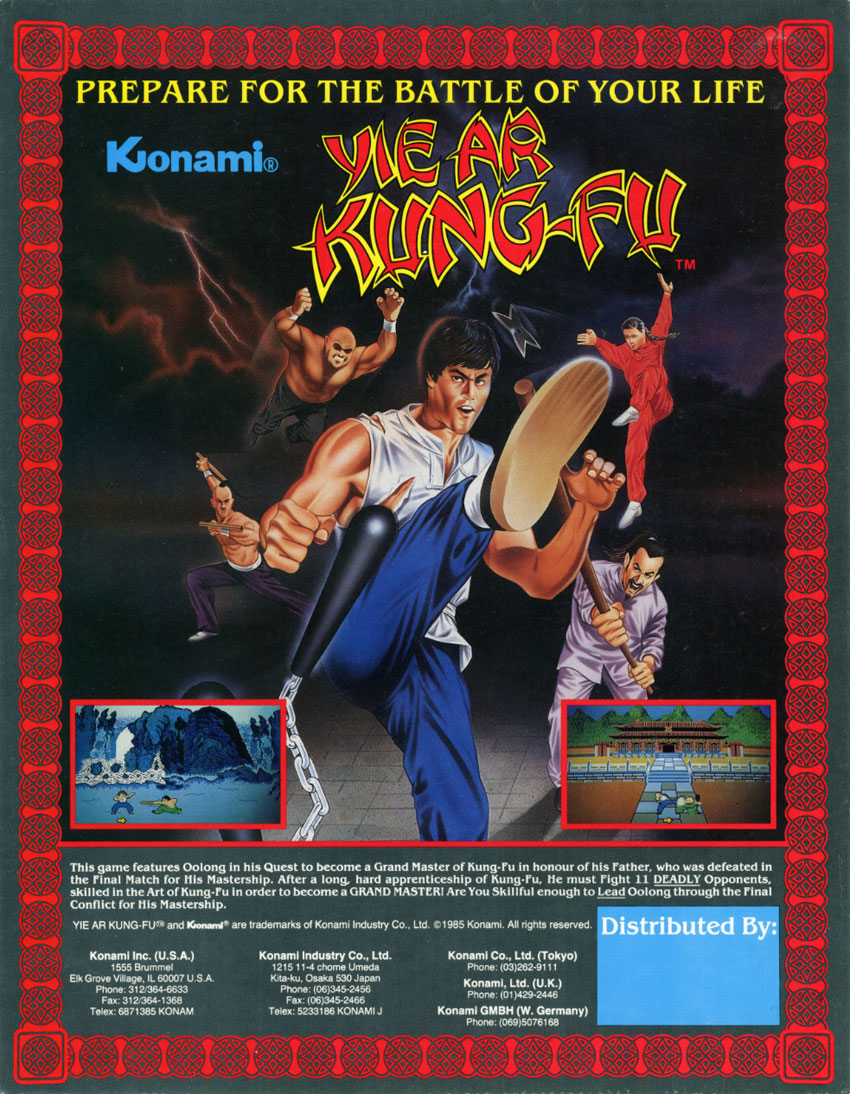
TWO-FER #25: Yie Ar Kung-Fu (Konami, 1984/1985)

Originally developed and released for the arcades by Konami Industry Co. Ltd. in 1984.

Acorn Electron & BBC Micro version written by Peter Johnson. Published by Imagine Software in 1985.

Amstrad CPC version written by Keith Wilson and Brian Beuken, with graphics by Brian Beuken. Published by Imagine Software in 1985.

Commodore 64 version:
Programming by David Collier
Graphics by Stephen Wahid
Music by Martin Galway
Published by Imagine Software in 1985.

Sinclair ZX Spectrum 48k version written by Brian Beuken, with loading screen by F. David Thorpe. Published by Imagine Software in 1985.

Sinclair ZX Spectrum 128k version written by Brian Beuken, Jonathan Smith, Mike Weeb, Paul Owens, Ian Martin, Tony Pomfret and Colin Gresty, with music by Martin Galway and loading screen by F. David Thorpe. (No further details are known.) Originally published as "Yie Ar Kung-Fu +2" in the "Stars On The 128" compilation by Imagine/Ocean Software in 1986.

Commodore 16/+4 version: no credits known, apart from being produced by David Ward; published by Imagine Software in 1986.

Game Boy Advance version released on the Konami Collector's Series: Arcade Advanced (US) / Arcade Classics (EU) compilation cartridge in 2002.

Unofficial conversion for the Atari 320XE written by Krzysztof Gora, with music by Michal Szpilowski and graphics by Daniel Kozminski and Krzysztof Gora. Released into public domain in 2006.

Also, official digital downloads of more or less the emulated arcade version were released for Xbox 360 in 2007, Windows in 2010, and Sony PlayStation 4 and Nintendo Switch in 2019. These versions will not be included in this comparison.

Completely re-designed for the MSX and Nintendo Famicom and published by Konami in 1985.

Game Boy version of the 1985 re-designed Yie Ar Kung-Fu released on Konami GB Collection Vol.3 compilation cartridge in 1997; the European version was released as Vol.4 in 2000.

The MSX version was ported to the ColecoVision by Opcode Games in 2005.

Unofficial conversion for the Sega Genesis/Megadrive based on the Famicom/MSX version written by Evgeny (with music engine by Shiru) in 2008.

---

INTRODUCTION & GAME STATUS


This October, we're going to have a bit of a weird sub-theme. Since 2021, October has been the month of games released by Ocean Software, at least in some regions, or some of the versions of the games in question at any given time. We still continue with Ocean to some extent, but this time, we're taking on a couple of Konami arcade games Ocean released under the acquired Imagine label. So that's basically three different publishers responsible for these two chosen games.

Friday, 1 September 2023

FRGCB's Let's Play series returns for another set of episodes!

While the comparisons are still on a break of sorts, it's time for another announcement. After an unnecessarily long break, we're back with another set of Let's Play videos. In case you haven't seen these videos before on FRGCB's YouTube channel, it's all unemulated gameplay footage with unscripted commentary of games I like to revisit more or less often.

This year, the plan is to get three more Let's Play videos out, with one platform that hasn't had a chance to get its place in the spotlight yet. For now, here's Saboteur on the ZX Spectrum. Enjoy!

Sunday, 13 August 2023

Scuba Dive (Durell, 1983)

Originally written by Ronald Jeffs for the Tangerine Oric-1/Atmos.

Converted to the Sinclair ZX Spectrum by Mike A. Richardson.

Converted to the Commodore 64 by Nigel Dewdney.

All versions published by Durell Software in 1983.

---

INTRODUCTION & GAME STATUS


While I was preparing FRGCB's special 10th Anniversary post, I realized I needed to focus more on games that would bring forth the superiority of versions made for other than C64. So, to start working on getting that balance more balanced, I start with another Durell classic that I used to play a lot back when I originally had a ZX Spectrum in the mid-80's.

Tuesday, 8 August 2023

FRGCB - 10 years and still kicking!


Exactly ten years ago today, I launched Finnish Retro Game Comparison Blog, without having a clear idea, what I was getting myself into. Sure, the basic idea was to give retrogaming enthusiasts "less biased opinions, more balanced reviews", but just how long a journey getting from relatively undetailed comparisons of games I thought would be somewhat simple to tackle, to the video-accompanied
ridiculously detailed comparisons they are now, has it been? And was it all worth it? Well, if anyone is interested in this sort of a thing, click on to read more about it, and look at some statistics while at it. Be warned, though, there are barely any pictures in this post, apart from the animated gif thing above.

Sunday, 23 July 2023

Stop the Express (Hudson Soft, 1983)

Originally designed and programmed for the Sharp X1 and Sony SMC-777 by Fumihiko Itagaki, and published as "Bousou Tokkyuu SOS" by Hudson Soft in 1983.

Ported to Commodore 64, Hitachi S1 and Sinclair ZX Spectrum by Hudson Soft, and respectively published in 1984 by Commodore Business Machines, Hudson Soft and Sinclair Research Ltd.

Ported to MSX by SoftBank, and published by Hudson Soft, Sony, Kuma Computers, HoneyBee Soft and Toshiba in various regions in 1984.

Unofficial conversion for Commodore Plus/4 by Csabo, with graphics by Chronos, and released by Legion of Doom in 2021.

Unofficial conversion for Mattel Intellivision by Carlos Madruga, with music and sound effects by Anders Carlsson, and released through Intellivision Collector in 2023.

---

INTRODUCTION & GAME STATUS


Hudson Soft's games haven't been all that well represented here at FRGCB, so I thought I might tackle at least one of them now. If you're first and foremost a fan of either Commodore 64 or Sinclair's ZX Spectrum line of computers, chances are that you might have missed Hudson Soft either by choice or by accident. Their games for those two computers didn't really scream Hudson Soft at you, although they were certainly responsible for some of the earliest Sinclair classics. Stop the Express was not necessarily one of the most well-known ones of the lot, possibly because it was already made during the time when Hudson was prioritizing their efforts on the Japanese 8-bit computers like Sharp X1 and MSX, but it became some sort of a cult classic. Only in the last few years, Stop the Express has gone through a revival period, with new versions for Commodore Plus/4 and Intellivision already out, and rumour has it, there are more conversions in the pipeline.

Monday, 3 July 2023

Gyroscope (Melbourne House, 1985)

Developed by Catalyst Coders.
Produced by David Wainwright.

Acorn BBC Micro and Electron versions written by David Wainwright and John Nixon.

Amstrad CPC version written by Tony Mack and Steve Lamb, with music by Gloryflow Ltd.

Commodore 64 version written by Mark "Dubree" Prosser, with music by Graham Davis and Rob Hartshorne as "Alphingwood".

Sinclair ZX Spectrum version written by Steve Lamb, Tony Mack and David Dew, with loading screen by Mark Alexander.

All the above four versions published by Melbourne House in 1985.

A version was also made for Apple II, with no credits known, and published by Melbourne House (?) in 1986.

---

INTRODUCTION & GAME STATUS


Marble Madness is one of Atari's most recognizable arcade classics, and has easily earned its status with no less than 15 (if not more) conversions in addition to the original. Isometric 3D games were big in late 1984, so having an isometric ball-rolling game with a trackball as your controller in the arcades must have been something very unique back then. Because of such an enormous amount of versions available, though, Marble Madness is likely to never be featured in this blog as a comparison. So, I decided to go with the next best thing: Gyroscope, which was developed for the 8-bit computers before the first home conversions of Marble Madness started coming out. This proved to be a relatively wise move from Melbourne House, since they later got the rights to port Marble Madness to some of the home computers.