
Retro games reviewed and compared as unbiased as possible by a Finnish guy, and occasionally helped by his friends.
Saturday, 2 April 2016
Updates - The Next Generation: Part MMXVI

Sunday, 27 March 2016
FRGR #04: Uuno Turhapuro muuttaa maalle (Amersoft, 1986)

Game design and programming by Pasi Hytönen
Music by Jori "Yip" Olkkonen
Co-produced by Petter Kinnunen for Amersoft, and Simo Salminen for Nasse-Setä Oy
Released for Commodore 64 in December 1986.
---
HISTORY, DESCRIPTION & GAME STATUS
The most obvious game to be featured in the series, Uuno Turhapuro muuttaa maalle has the honour of being simultaneously the most frustrating Finnish game ever released on the 8-bits, and the most sought after Finnish C64 game of all time, if only because it's so well-known. The most recent spotting of the tape version of the game being auctioned at huuto.net earlier this year reached 500 euros, and the tape version is the more common one, since around 2000 copies were pressed of those, while the disk version had a much smaller print - only about a 100 copies were made! For the quality of the game, I'm hesitant to vouch for, but merely for what it represents, it has definitely earned its firm spot in the commercial history of Finnish games.
Sunday, 20 March 2016
The Sacred Armour of Antiriad (Palace Software, 1986)

Plot and graphics by Daniel Malone
Sound design by Richard Joseph
Originally released for the Amstrad CPC in 1986.
Converted for the ZX Spectrum and Commodore 64 by Stanley Schembri in 1986.
Converted for the IBM-PC compatibles and Apple ][ in 1987 by Stanley Schrembi and Craig Seastrom. Converted for the TRS-80 CoCo by Jesse Taylor in 1988. The Commodore 64, IBM-PC, Apple ][ and TRS-80 CoCo versions published in North America by Epyx as "Rad Warrior".
---
INTRODUCTION & GAME STATUS
Now, here's a game I have to admit having an almost complete ignorance on, even though I came across it plenty of times back in the day. The Sacred Armour of Antiriad, or just plain Antiriad, as it was often referred to, never caught my fancy due to its initially awkward controls and slightly more than usually restrictive flip-screen system. Only lately I have found out that there is actually more to this game than just walking around naked in a jungle, dying randomly on things I don't understand, and since a comparison of Antiriad was suggested a good while back in a blog comment posted by Brain Breaker in 2014, I thought I might as well try and learn to play this game now, almost 30 years after its release. Better late than never, right?
Sunday, 13 March 2016
NGOTM & TWOFER: The New Dimension Special!

Concept based on "Crazy Balloon" arcade game by TAITO from 1980. Programming and music by Richard Bayliss. Graphics by Richard Bayliss and Hiram Kumper. Loading screen by Marq Watkin. Originally released as freeware for the Commodore 64 in 2001 by the New Dimension, and published by Cronosoft in 2003. Converted for the Amstrad CPC by Kevin Thacker, and published by Cronosoft in 2007.
Sub Hunter
Concept based on a Commodore VIC-20 game "Sub Hunt" by Mastertronic from 1984. Programming by Richard Bayliss. Graphics by Frank Gasking. Music by Thomas "Drax" Mogensen and Richard Bayliss. Originally released for the Commodore 64 in 2008 through Psytronik Software.
Converted for the Amstrad CPC by Paul "Axelay" Kooistra, with music by Herve Monchatre. Released in 2011 through Psytronik Software.
---
GAME STATUS, PLURAL
All right, so we have a curious little twofer here this time: it's simultaneously a New Game Of The Month special entry, although neither of these games are particularly new anymore, only released well after the two machines' commercial demises. Also, neither of these games are particularly original - rather remakes of over 20 year old titles, so I shall be taking a quick look at the original games the two remakes are based on, as well.
Saturday, 5 March 2016
Eliminator (Hewson Consultants, 1988)

Converted for the Commodore Amiga by Linel: Programming by Christian Haller and Christian A. Weber, Music and sound effects by Roman Werner, Graphics by Pete Lyon, Title screen by Michael Tschoegl.
Converted for the Amstrad CPC and Sinclair ZX Spectrum by John Wildsmith, with sounds by Nicholas A. Jones. Graphics for the Amstrad version by Hugh Binns and for the Spectrum version by Stephen Crow.
Converted for the Commodore 64 by Tim Rogers, with graphics by Darrin Stubbington and Hugh Binns, title screen by Stephen "SIR" Robertson and sounds by Jeroen Tel for Maniacs of Noise.
All versions released in 1988 by Hewson.
---
GAME STATUS
Here's something that this blog hasn't featured in quite a while: a game that was made for all three principal 8-bit computers, that these sorts of comparisons usually are focused on, as well as the two next-generation computers that went through a similar battle of "whose reproductive organs are more appropriate for the job" as the three 8-bits. If only the MSX and 8-bit Atari computers were included here, it would be perfect. But curiously enough, Eliminator was first made for the 16-bit Atari, so that's something to consider with a bit of seriousness. Particularly as it is also one of the select few three-dimensionally behaving games featured on the blog so far. And if that's not reason enough to write about Eliminator, then at least having included it in the teaser picture in last August should give me some excuse to do this now.
Saturday, 27 February 2016
Frak! (Aardvark, 1984)

Designed and programmed by Nick "Orlando" Pelling for the Acorn BBC Micro in 1984, and converted for the Acorn Electron in 1986.
Converted for the Commodore 64 by Jason Perkins, Anthony Clarke and Mark Rodgers, and published by Statesoft in 1985.
---
INTRODUCTION & GAME STATUS
For a change, we have a slightly edited blog version of another RESET magazine article for you all to browse through. And once again, if you haven't read the original magazine yet, you can do so here. Now, I've been trying to put our C64 against a different machine for each Format Wars article, whenever possible, and since it's the sixth article in the series already, it's inevitable that the game under the magnifying glass should be a more obscure one. I never knew much about the Acorn computers, since we didn't get them here in Finland, but believe it or not, Frak! was one of my favourite platformers on the C64 back in the day, because it was deceivingly simplistic in its mechanics, but completely unique in certain ways. Finding out only lately, that it was originally made for the Acorn computers came to me as a bit of a shock, so of course I had to do a comparison of it as I test the original game for the first time.
Sunday, 21 February 2016
FRGR #3: Miner Machine (Boss Company, 1987)
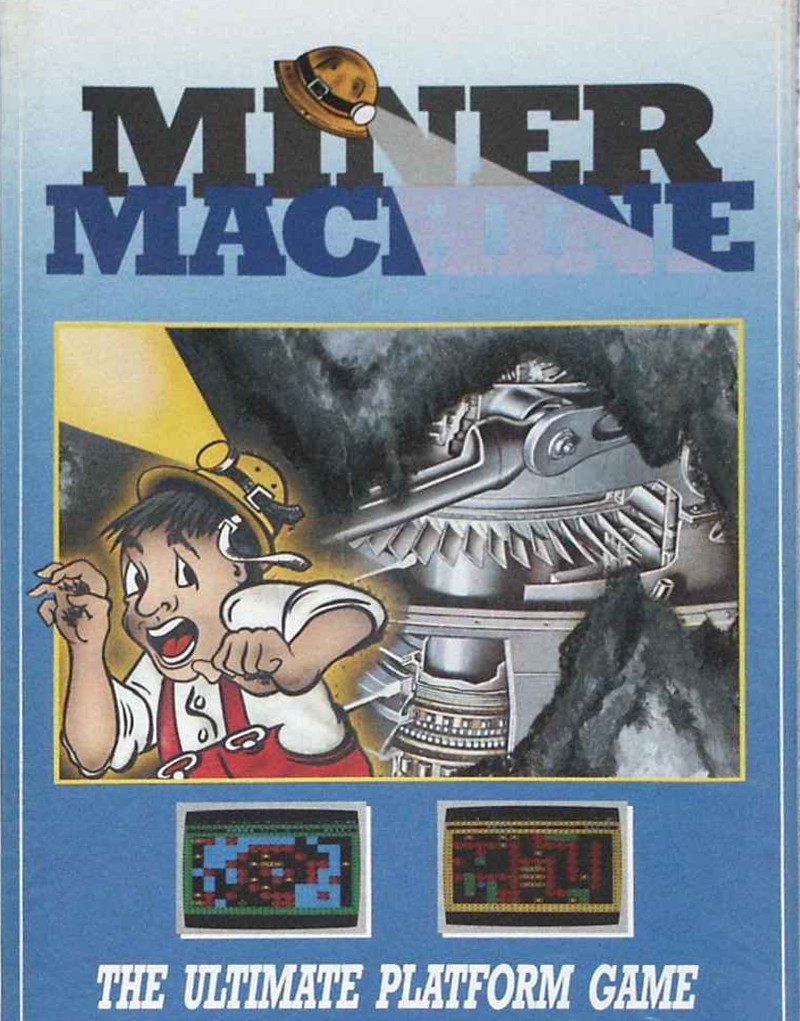
The original Finnish release published by Boss Company in February 1987, and later the same year, published by Eaglesoft in France (from which the cover art here is taken) and by System 4 in Spain.
---
DESCRIPTION & GAME STATUS
Merely for the sake of change, I decided to take a look at something not C64-based this time. Although there were quite a few Finnish games released for the MSX (and SVI) computers, most of them are still unavailable on the internet. Miner Machine is one of the rare examples of Finnish MSX games that are available, so I decided to take a closer look at it.
Subscribe to:
Posts (Atom)